
How to turn email marketing into a revenue engine, not a broadcast channel
Your segments aren’t underperforming. They’re underowned.

Lifecycle email has an image problem. Ask most marketing teams what email marketing is for, and they'll describe a newsletter — a monthly broadcast, dutifully sent, vaguely tracked. Ask what it could be, and the honest answer is: your highest-ROI channel, sitting almost entirely idle.
Noah Adelstein, writing on The GTM Engineer, diagnosed the real problem precisely: lifecycle marketing isn't underperforming because the tactics are wrong.
"Lifecycle programs die from nobody owning them daily rather than from bad sequence."
It's not a strategy problem.1 It's a staffing problem wearing a strategy costume — and most teams don't have the headcount to fix it the old way.
Why segmentation quietly never happens
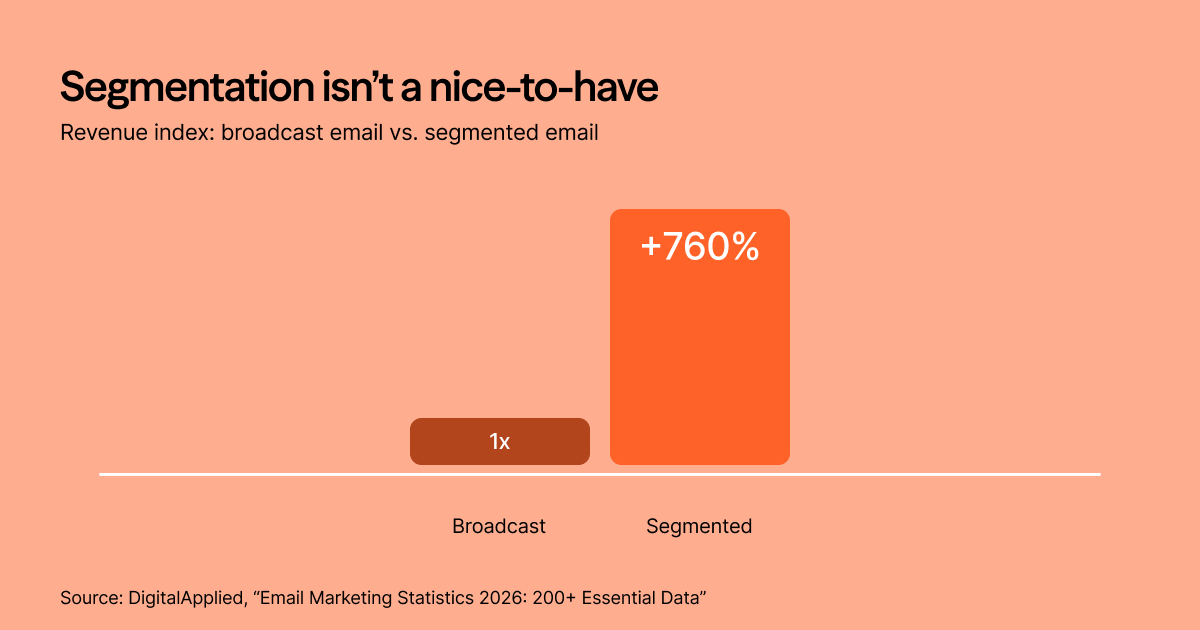
Ask a marketer whether segmentation works and they won't hesitate: segmented campaigns generate 760% more revenue than one-size-fits-all broadcasts, and 94% of top-performing email programs run on three or more segmentation criteria at once.2
Ask that same marketer why their own list still gets one undifferentiated blast a month, and the answer gets quieter. It's rarely "I don't believe in it." It's "I don't know where to start, and I'm afraid to break something that's already held together with tape."
Take a look at most CRMs and you're not looking at a strategic asset. You're looking at a junk drawer: duplicate contacts, stale tags, three naming conventions for the same audience, an imported list nobody remembers the source of.
Segmentation requires trusting the data enough to act on it, and for most marketing teams, that trust was never built — so the safest move becomes the one that requires no judgment call at all: send everyone the same thing.
For D2C and multi-location brands, the problem compounds. Loyalty activity lives in one system, in-store or in-venue transactions in another, email engagement in a third — a restaurant group's point-of-sale system knows exactly what a guest ordered, while its CRM barely knows the guest exists, and neither one is talking to the email platform.
The average business now pulls customer data from seven to ten separate platforms just to run personalization at all.3 Try building a segment for "ordered twice in the last 60 days but hasn't opened the last three emails" and the answer will require cross-referencing three logins, two exports, and a spreadsheet nobody has time to keep current. So the monthly newsletter blast stops looking lazy and starts looking like the only option that didn't require solving a data problem first.
None of that is a strategy failure. It's an access failure — and it's exactly why "own it daily" beats "own it perfectly."
It's a habit, not a campaign
The fix was never "work harder." It's lowering the cost of doing the thing you already know you should do. Adelstein's framework does exactly that for email, in six steps:
- Set up your foundation — brand identity, sending domain, the boring infrastructure nobody wants to own but everybody needs.
- Connect what you already have — your CRM, your AI tools, the systems that already hold your customer data.
- Describe the campaign instead of building it. This is the actual unlock: you're not hand-coding a sequence in a drag-and-drop builder anymore. You're telling the system what you want it to do.
- Review before it ships. Speed doesn't mean removing judgment. It means moving judgment to the review step instead of the build step.
- Analyze what happened, and let that inform the next send. Every campaign becomes training data for the next one.
- Own it lightly, but own it daily. Adelstein's own benchmark: about 5% of a person's time, sustained, rather than one person's whole job, occasionally.
The result, in his own numbers
2x+ open and click rates on new campaigns
~5% of one person's time to sustain the program
Teams following this framework reported that new campaigns "more than doubled open and click rates," while shifting from occasional monthly newsletters to sophisticated, segmented, multi-step sequences1 — the kind of program that used to require a dedicated lifecycle hire, run instead by someone spending a sliver of their week on it.
The takeaway: You don't need a bigger email team. You need a smaller, daily commitment and a system that can execute on it without waiting for a free Tuesday afternoon. The channel was never the problem. The ownership model was.
Sources
- Noah Adelstein, "How to Turn Email Marketing Into a Revenue Channel," The GTM Engineer (Aug 20, 2026)
- DigitalApplied, "Email Marketing Statistics 2026: 200+ Essential Data"
- Shopify, "Unified Customer Database: How to Build One (2026)"
Related posts

Build or buy? Buy, and here's why.
Marketers don't need to be AI engineers. They need to be AI-willing — and let a team designed for nothing else do the building.