
OODA Loop
The OODA Loop for modern CMOs
Pip closes the decision cycle faster than your traditional partner agency structure can.
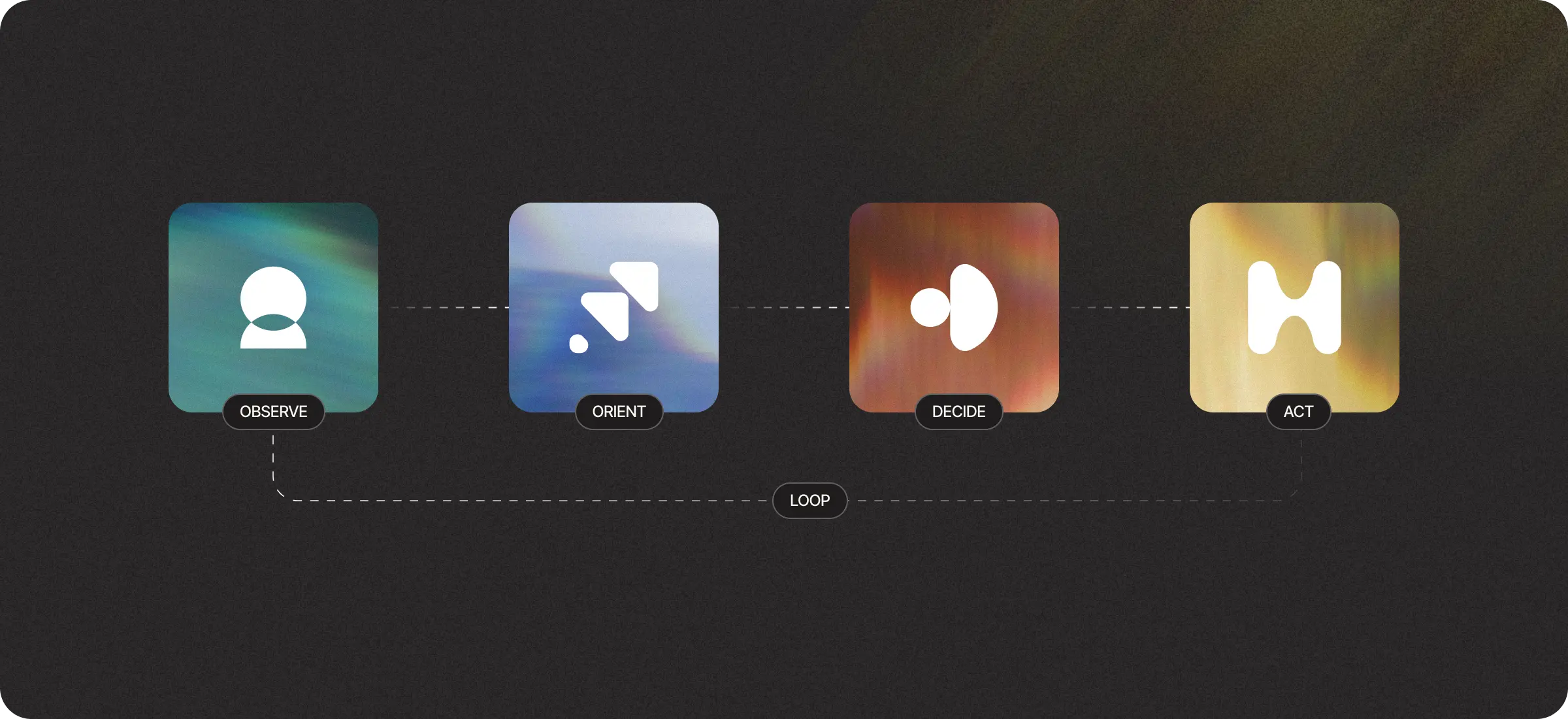
What is the OODA Loop?
OODA: Observe, Orient, Decide, Act. It's a decision-making cycle developed by military strategist John Boyd. The core idea: whoever moves through this loop faster, with better information, wins.
For CMOs today, the "opponent" isn't just market noise and fragmented data. It's also dependency. Relying on external support adds friction.
For CMOs today, the "opponent" isn't just market noise and fragmented data. It's also dependency. Relying on external support adds friction.

Observe
See everything, in one place
Most marketing teams "observe" through disconnected sources: ad platform dashboards, a CDP they don't have, spreadsheets, and their agency's weekly report. By the time you've pulled it together, the moment's gone.
Pip starts by unifying the data layer, building the customer 360 view from existing systems. On top of that, Pip's Signals feature give you a standing observation layer: automated monitoring with severity weighting, so a spike in ad spend or a shift in campaign performance surfaces as a proactive alert, not something you find three weeks later during a QBR, or in an agency report you had to chase.
Pip starts by unifying the data layer, building the customer 360 view from existing systems. On top of that, Pip's Signals feature give you a standing observation layer: automated monitoring with severity weighting, so a spike in ad spend or a shift in campaign performance surfaces as a proactive alert, not something you find three weeks later during a QBR, or in an agency report you had to chase.

Orient
Turn data into a clear picture, in natural language
Orientation is where most teams lose time: translating raw data into "what does this actually mean for our strategy?" Pip does this through natural language. Instead of manually cross-referencing five reports, or waiting on someone else to interpret the numbers for you, you can ask Pip a question and get it to look at all your channels, straight from the source.
This is also where Pip's Workflows earn their keep: automated processes that pull from multiple sources and deliver whatever you need.
This is also where Pip's Workflows earn their keep: automated processes that pull from multiple sources and deliver whatever you need.

Decide
From insight to sure-fire recommendation
A good OODA loop doesn't just inform a decision, it makes the decision obvious. Pip is designed to move from insight to a recommended, ready-to-execute action, not just a dashboard you still have to interpret, or a strategy deck you're waiting on someone else to hand over.
For CMOs, that means less time in analysis paralysis, less time waiting on a call back. It means more time acting on a clear, data-backed recommendation you own end to end, whether that's reallocating spend across channels or launching a campaign to a specific segment.
For CMOs, that means less time in analysis paralysis, less time waiting on a call back. It means more time acting on a clear, data-backed recommendation you own end to end, whether that's reallocating spend across channels or launching a campaign to a specific segment.

Act
Execute a full campaign in minutes, not weeks
This is where Pip diverges most from a traditional martech stack or a traditional agency retainer. Pip actually does the work.
We call this the "20-minute campaign": compressing what typically takes a lean team days of coordination or briefing an agency into a single prompted workflow. It lets one person do the output of several channel specialists, without needing to be one.
We call this the "20-minute campaign": compressing what typically takes a lean team days of coordination or briefing an agency into a single prompted workflow. It lets one person do the output of several channel specialists, without needing to be one.

Speed matters more than any single channel
Boyd's insight wasn't that any one stage mattered most. It was that a faster, tighter loop wins. Your biggest risk is being slowed down by disparate data sources or a hierarchical agency structure.
Pip's role isn't to replace marketing judgment or replace your team with a tool. It's to compress Observe → Orient → Decide → Act into a cycle fast enough, and self-sufficient enough, that you're never reacting to data that's already stale, or waiting on someone else to tell you what it means.
Pip's role isn't to replace marketing judgment or replace your team with a tool. It's to compress Observe → Orient → Decide → Act into a cycle fast enough, and self-sufficient enough, that you're never reacting to data that's already stale, or waiting on someone else to tell you what it means.
