
Agentic marketing, explained: What changes when your campaigns run themselves
The difference between automation and agency is the difference between a checklist and a chief of staff.

Every category needs its origin myth, and "agentic marketing" has already collected a few. Some people use it as a fancier word for marketing automation. Others use it to mean "an AI wrote this email." Neither is right, and the distinction matters more than the terminology debate suggests.
What automation actually was
Marketing automation, the thing most of us have been running for a decade, executes rules. If a lead fills out a form, send email A. If they click, send email B. If they don't, wait three days and send email C. It's a flowchart with impeccable memory and zero judgment. You build the logic, and it keeps running it until told otherwise.
What changes with agentic marketing
Agentic marketing flips the input. Instead of handing the system a workflow, you hand it a goal.1 You say "grow qualified pipeline from mid-market retail accounts this quarter," and the system plans the campaign, chooses the channels, generates the personalized content, sequences the outreach, watches what's working, and adjusts — without you specifying the if-then logic in advance.2
The industry's shorthand for this: automation executes; agents decide.3
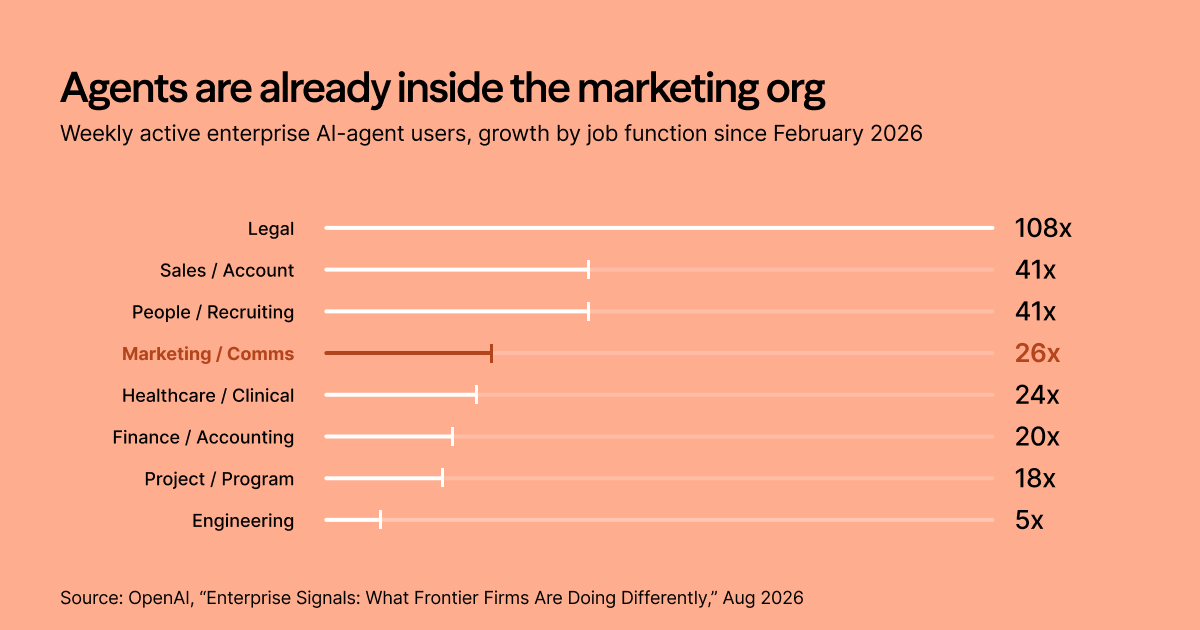
Three things actually change when this happens:
- The unit of instruction changes. You stop briefing tasks and start briefing outcomes. That's a genuinely different skill, and most marketing teams haven't practiced it yet.
- The feedback loop shortens. A rules-based system runs the same play until a human notices it's stale. An agentic system is meant to notice first.
- Judgment moves, it doesn't disappear. BCG's research on agentic marketing transformation is blunt about this: the technology is real, but most organizations are still treating it as a pilot rather than restructuring how work actually gets assigned and reviewed — which is where the value is supposed to come from.4
The principle underneath it
It's an old idea, newly industrialized: you don't get more capable by doing more tasks. You get more capable by getting clearer about outcomes and building systems that don't need you to babysit every step.
Agentic marketing is that principle, running at software speed. The campaigns don't run themselves so much as they run your intent, continuously, at a speed no calendar of manual sends could match.
If your team is still writing briefs that specify channel, subject line, and send time, you're managing automation. If your team is writing briefs that specify audience, goal, and guardrails — and letting the system figure out the rest — you've crossed into agentic territory.
Sources
Related posts

Build or buy? Buy, and here's why.
Marketers don't need to be AI engineers. They need to be AI-willing — and let a team designed for nothing else do the building.