
How to Win Black Friday and Cyber Monday in 2026
Written by Nicola Ryan, a Passionfruit Partner and Growth Marketing Leader

Everyone talks about BFCM (Black Friday and Cyber Monday) planning. But once you hit the holiday period, there's not a lot of time for planning. There's a lot of time for reaction.
It's the Super Bowl for ecommerce. For plenty of brands, the window from mid-October to December 20 can drive close to 40% of the year's revenue, and December can even pull in more than Black Friday and Cyber Monday combined. When that much rides on a few weeks, you can't wait for the weekly report. You have to see what's changing, make a call, and ship daily.
This year is going to be interesting. There's a lot going on with the economy and with AI, and Thanksgiving falls on November 26, which is pretty late. That means a relatively short shopping season and a little extra pressure on everyone. And early Black Friday deals will start showing up any day now. Guaranteed.
So here's how I think about winning the next few weeks, and where I'd want AI doing some of the heavy lifting.
1. Check in every day. Literally every day.
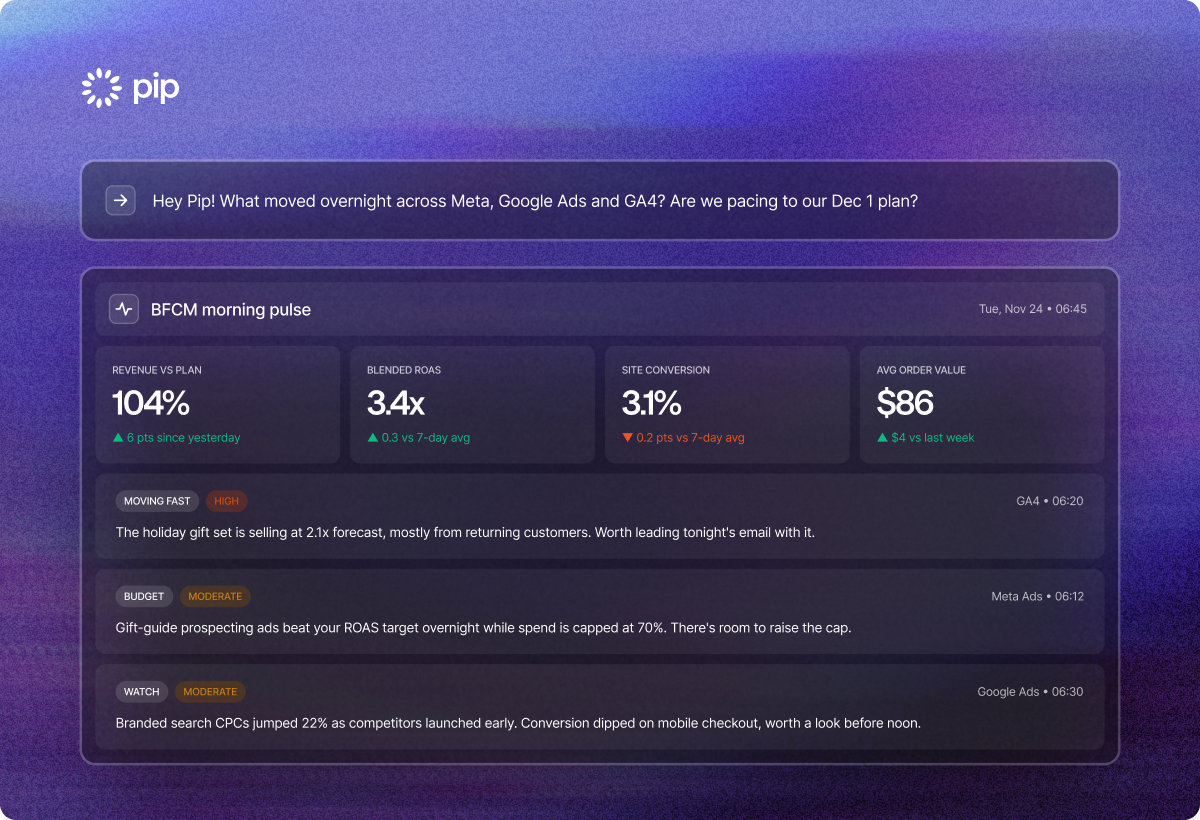
Every time I've run BFCM, it's been a daily check-in, not a weekly one. What's changed? Are we on track? How has the hourly stuff shifted? Are we missing things? Are there products moving faster than we thought, and should we be pushing them harder?
The hard part is that answering those questions usually means pulling exports from five platforms before anyone can make a call. That's the first thing I'd hand to a tool like Pip - Passionfruit’s marketing-native AI sidekick. Plug it into the stack you already have, ask what moved overnight in plain English, and get an answer across every channel before your first coffee. Tweak the report to include your most important metrics, and allow for quick, data backed decisions.
2. Know what your competitors are doing, and when
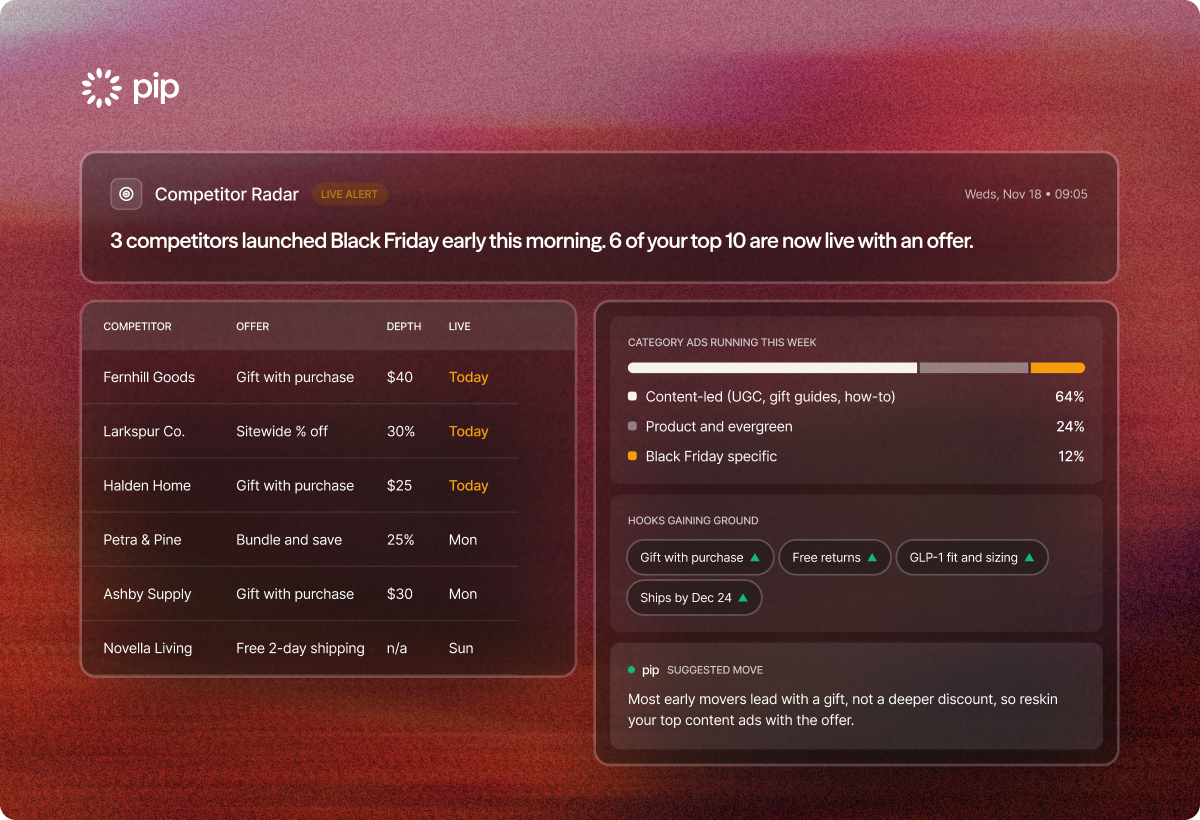
Your competitors' offers and timing should shape yours. If six of your top ten competitors are running a gift with purchase, that tells you something. If you notice their early Black Friday started today, on a Tuesday, maybe you need to move your launch up from Friday to Wednesday just to be competitive.
Most teams find this stuff scrolling Instagram at night or conducting manual research. I'd much rather have an agent watching it for me: who's discounting, how deep, what kind of offer, and knowing the second it goes live. Pip has a competitor analysis agent, called Competitor Radar, built for exactly this, and honestly it's one of the smartest uses of AI I can think of for this time of year. Quick reskins of competitor ads can be made faster than ever, so make sure your team has plenty of B-roll and templates ready so they can spin up new ads quickly.
3. Look at the ads, not just the offers
It's not only about the discount. Scrape the ads in your market and break them down. You might find that only 10% of them are Black Friday specific and most are actually content. That's useful. It means your team can reskin ads or change hooks to match what's working for your competitors.
It also catches themes you'd otherwise miss. A lot of brands are really leaning into GLP-1 as a hook right now. Maybe your product isn't particularly relevant, but people who are using it immediately feel seen when you call it out. Take apparel: "Worried about your clothes fitting? Remember, we have a 30-day free return policy. If you lose 10 more pounds before the end of the month, no worries, just go down a size.” Grüns and IM8 have both used this playbook to great effect.
4. Use the traffic. Your tests will resolve faster.
You have a ton of traffic during the holidays, so an A/B test resolves much faster than it would in July. More eyeballs, faster significance. That means you can test something, call the winner, push it and move on to the next one, all in the same week. Often, brands will have many tests running and with so many priorities, a test may reach significance without notice.
What slows teams down usually isn't the test. It's somebody noticing the result and doing something about it. Rapid testing with rapid winner calls is high on my wishlist for any AI tool in this period. I have made sure that my tools are set up to tell me the moment a test hits significance and help me push the winner asap.
5. Find the cohorts that aren't buying
Break down your CRM offers. Which ones worked, which didn't, and which cohorts didn't respond at all? Split your customers by LTV band, AOV band or product, see who's responding to what, and look for the gaps. That's where you hit people with a different offer.
Say I'm looking at last year's Christmas shoppers and no one's buying this year. I wonder why. Maybe a quick report shows most of them bought a product that doesn't exist anymore, or got updated. Now I know how to go after that cohort. That's the kind of quick hack that unlocks revenue, and with Pip it's a question you can ask in a prompt mid-season instead of a project for January.
One easy way to set yourself up for success is to ask the questions you’d ask in a retro now. This will help you determine how to best set up your tools to help you answer these questions in flight, and time you spend before BFCM to set up automated processes will free up time to react!
6. Cyber Monday isn't the finish line
Lots of brands keep their offer going after Cyber Monday. They just rename it, or drop it from 40% to 30% for the rest of the holiday. And for a lot of brands, December pulls in more revenue than BFCM itself, though it is built on the bones of the work done in November. Ensuring that you continue to hit site visitors, and that you are providing customers with offers that matter most to them, at the moment of need.
A big part of that is shipping as we run up against gift-giving timelines. How are you prioritizing free shipping? How are you incentivizing expedited shipping? How are you capturing the guy who realizes it's December 19 and he forgot to get a gift for his wife?
A huge opportunity here is to test free shipping options (expedited, two day, overnight, etc.). That can still be margin accretive, because you're getting that customer so cheap. In the last 10 days before the shipping cutoff, I'd be rolling out shipping offers market by market and checking every day which ones are working, with strong partnership from my ops and finance teams. Start with onsite offers as these will lift CVR for the totality of your traffic.
7. Do the retro properly, then let it remind you
People always talk about retros, but people seldom do them with rigor. By January, nobody wants to piece together every change they made in November and what it actually did.
This is where I think AI can do most of the work for you. I want a tool that summarizes every change we made through the period, where things went positive and negative, and gives me a readout: here's what worked, here's what didn't, here's how to change it for next year. Then come next July, I want to get prompted. "Hey, remember this. You ran 10% more partnership ads last year, and they performed 30% better than the year before. Let's push more partnership ads this year." That way you get the right content in place before the chaos starts again.
The TLDR
BFCM is always a crazy period. You're not going to out-plan it, but you can react faster than everyone else. Check in daily, watch your competitors, use the traffic to test, go after the cohorts that have gone quiet, and don't stop at Cyber Monday. Then capture all of it, so next year starts smarter.
Anyone you ask will have a different list, which is kind of the point.
Nicola and the Passionfruit team are hosting a breakfast for Ecomm and Marketing leaders on December 9th in New York City. If you’d like to discuss any of the above points and sync before closing out the month, RSVP here for a seat. Spots are limited.