
Neobanking reloaded: Propsa vs Telda vs Finzi etc

With Monzo, Revolut, N26, Starling, Curve and more already present in Europe alone, and about 25 major players in the US, it seems hard to imagine that there’s room for any more neobanks out there.
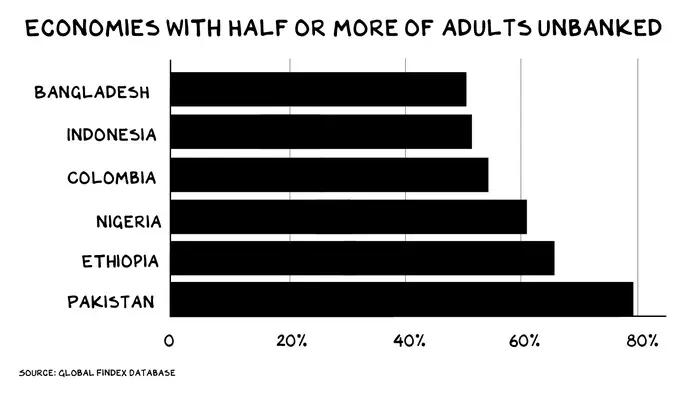
The reality, however, is that there’s a lot more room to run for the brightly-coloured, softly-spoken startups that want to bring digital banking to the masses. It’s estimated that at least 1.7bn people in the world are “unbanked”, but that rate is declining by approximately 300m every 3 years. As a rough rule of thumb, therefore, each year there are 100m new customers available to neobank startups.
Even if you just managed to take $100 in annual recurring revenue (ARR) from one percent of the new customers available annually, you’d have $1m ARR. It’s no wonder that VCs are pouring money in so fast. But of course, incumbents want a slice of this pie as well. So how can startups compete? What tactics can they employ to take on the Big Orange Beast and corporations like JP Morgan’s new “Chase” offering that lie in wait?
Who are the contenders?
- Flobiz: “An Indian startup that is building a neobank for small- and medium-sized businesses in the South Asian market.”
- Novo: “A neobank that has built a service targeting small businesses.”
- Juni: “The Financial Companion Made For Digital Entrepreneurs. Juni tracks your entire business in one place. Tailor made for the marketing & e-commerce ecosystem.”
- Cardless: “Cardless is a credit card company focused on helping today's most exciting brands launch credit card products for their superfans.”
- Paperchain: “The only card that gives you instant access to your creative income. Built for online creators.”
- Finzi: “Finzi is a digital banking and learning platform that provides bank accounts for teens in Colombia.”
- Koto: “Koto Card provides stress-free credit options via a convenient app.”
- Prospa: “Your banking & business in one place. For Nigerian entrepreneurs.”
- Telda: “Telda exists to digitize how Egyptians save, send and spend money.”
- Kard: “Kard is building a challenger bank specifically designed for teenagers.”
- Walrus: “Payments app and debit card for Gen-Z in India.”
Lose the western-centric approach
Professor Scott Galloway of NYU, on his recent podcast, spoke with CEO of Argentine neobank Ualá, Pierpaolo Barbieri. To quote, “in just four years, more than three million people have opened an account with his company — about 9% of the country — and over 25% of 18 to 25-year-olds now have a ‘tarjeta Ualá’ (online wallet).”
Achieving that level of market penetration in under five years is astonishing to an American or British mindset; where competition in the space is so fierce. But outside of the Western bubble there are markets that remain more or less untouched by digital banking. It’s no wonder big VC firms like Sequoia are so bullish on their recent investment in Telda, which is focussed on Egypt, or why YCombinator said ‘yes’ to Nigerian-focussed Prospa.
However, these sorts of signals will invariably entice some of the major players to set up localised, international operations. In fact, Revolut has already tapped Paroma Chatterjee, a former executive at Indian start-ups Flipkart, Via.com and Lendingkart, to set up its operations in the country, ahead of a formal launch in 2022 with $25m to support marketing efforts. With existing economies of scale in place for Revolut, the race is on for the likes of Walrus and Flobiz to establish a foothold before the heavy artillery arrives.
Get granular and build for one audience
Concretely there are a few different ways that fledging startups can build footholds to prepare for competition with giant incumbents, let’s break down a few of them:
- Build a toehold first: It might seem risky to adopt a model like Finzi’s - which is exclusively focussed on teens in Colombia; a demographic population of just over eight million people - but you can be certain that nobody has a better chance of winning all of those eight million than Finzi. In other words, full control over a beachhead gives you a platform to grow, whereas a loose invasion of the whole beach leaves you spread thin. Product marketing is the art of positioning your product against a competitive set with messaging, pricing and packaging designed to appeal to a specific group of consumers - investment in nailing that value prop will reap big rewards.
- Provide surprising levels of value and utility: By building properly for one specific group, as opposed to building poorly for lots of different groups, you can include features and functionality that delight customers. For instance, it’s crazy that with all the neobank innovation in the UK, when Gen Z and millenials go on holiday and want to split costs - anecdotally they almost always use Splitwise; a separate, unaffiliated app to their banking provider. Thinking deeply about what you can incorporate into your banking service that saves your users’ the hassle of using another app will drive higher levels of customer retention (LTV) while also driving down customer acquisition costs as word of mouth spreads faster. If you’re able to introduce an incentivised referral layer on top of that product feature, your word of mouth will spread faster still.
- Have faith in the organic game: The temptation for pre-product-market-fit B2C startups is always to pour money into paid social and paid search ads to beef up user numbers and revenue growth. The truth is cost-effective, viral distribution channels don’t work in the way they used to and, as Andrew Chen has noted, they often lead to traction treadmills:
“The traction treadmill eventually arrives once the numbers get big. This is when you lose a % of users fast, but then just have the budget and funding to replace them- but then can’t keep grow on top. Eventually on a base of millions of users, you might churn a million users, and need to replace them — and buy more, to grow. So then you’re starting to talk about very large outlays, just to stay afloat, much less to consistently grow.”
Unless you can be one of the few that masters a newer lane like Reddit, Quora or Nextdoor, or you have some truly best-in-class support in a less competitive area, becoming addicted to paid growth risks the long term success of your startup. Iterating on product while you build brand and sales more organically through the killer combination of PR, Content Marketing and SEO (where high-authority backlinks and keywords deliver search prominence) is a much more sustainable way to proceed.
