
Reporting is where agentic AI will prove itself first. Here's why.
The unglamorous work is where trust gets built. Start there.

The agentic marketing future isn't going to arrive as one dramatic campaign that runs itself. The category's actual breakout use case will be much smaller, running quietly, every single week: your reporting.
The case for starting boring
Reporting and analytics are already the second most common way marketers deploy AI, just behind content generation.1 That's not an accident — it's the workflow with the clearest inputs, the most repeatable structure, and the lowest cost of being wrong on a first attempt.
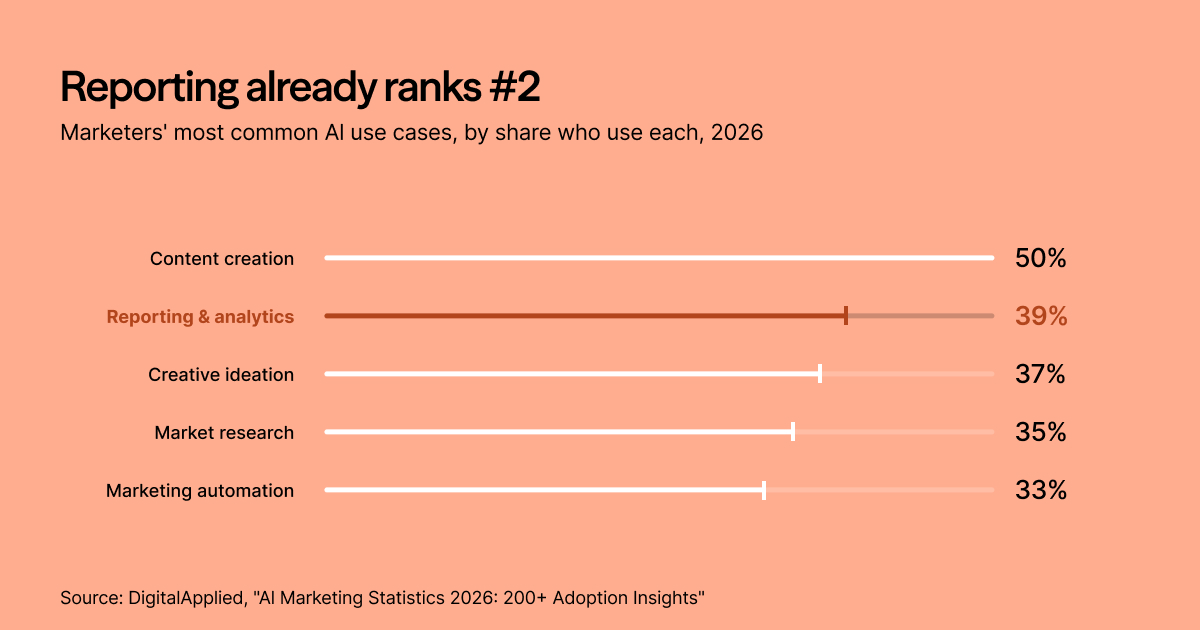
That combination — high frequency, low blast radius, clear right answer — is exactly the profile that makes an AI agent trustworthy fast. And the returns back this up. Successful agent deployments focused on specific, well-defined workflows report 4.1x to 5.3x ROI, substantially higher than general-purpose AI tooling spread thin across vague use cases.2
Marketing automation overall is already returning $5.44 for every dollar spent.3 Reporting doesn't need marketing's imagination. It needs marketing's discipline, applied consistently, and agentic tools are built for exactly that.
Why this matters more than it sounds like it should
Trust always works the same way: you don't ask for someone's confidence before you've earned it on something small. The same logic applies to handing an AI agent more autonomy inside your marketing org.
A team that has watched an agent compile, check, and explain its own reporting correctly for eight straight weeks trusts that agent differently than a team handed a black-box "autonomous campaign" on day one.
79% of companies are now adopting AI agents in some form, and 66% of those adopters already report measurable value4 — but that value compounds fastest when it starts on tasks the team can verify at a glance.
What this looks like in practice
- Let the agent assemble the whole report, not just a chart. The value isn't the visualization. It's the agent pulling from every disconnected source your team currently reconciles by hand.
- Keep a human in the loop on the interpretation, not the arithmetic. The agent should never be the one deciding what a number means for strategy — just the one making sure you're looking at the right number, on time, every time.
- Use it as the on-ramp, not the destination. Reporting is where your team learns to work alongside an agent. That trust is the actual prerequisite for the more ambitious agentic marketing use cases everyone's excited about.
Your agentic breakthrough will most likely arrive as a Tuesday morning report that used to take four hours and now takes four minutes — accurate, on time, every week, until nobody remembers it used to be a chore. Who knew boring could be so exciting.